The challenge: evaluating sensitive data quickly and securely
The Hexagon team took on the task: “We received a set of test data and used it to start the training for Deep Segmentation in VGTRAINER,” explains Patrick Fuchs, Product Owner AI, VG Software at Hexagon. “VGTRAINE learns from curated datasets, enabling users to quickly and easily create and refine the deep neural network required for accurate segmentation,” says Fuchs. “Our goal was to prove that reverse engineering of circuit boards is possible — even with minimal time expenditure.”
The solution: AI-based training for successful Deep Segmentation
To train the deep neural network as precisely as possible, training data is required. This can be prepared in VGSTUDIO MAX. “First, we ‘cut’ a block from the dataset in which we manually perform the segmentation and labeling,” says Fuchs. The team then exports this data to VGTRAINER. “No machine learning expertise is required for this, and the most common parameters are already integrated into the software.” While training runs quickly with a small dataset, the expert recommends preparing multiple blocks to cover the various characteristics of a circuit board. “We focus on the sections where the evaluation shows the most errors during a test run,” Fuchs explains.
Accurate and, above all, consistent labeling of the training datasets is crucial. “There is no limit to the number of blocks we can feed into the system,” Fuchs adds. “But the larger the amount of data available to the deep neural network, the more accurate the Deep Segmentation results — and the faster the analysis process will ultimately run.” In this way, the team trained the VGTRAINER software with the characteristics of the circuit boards, creating a comprehensive foundation for the rapid evaluation of new CT scans of other circuit boards in the associated software, VGSTUDIO MAX.
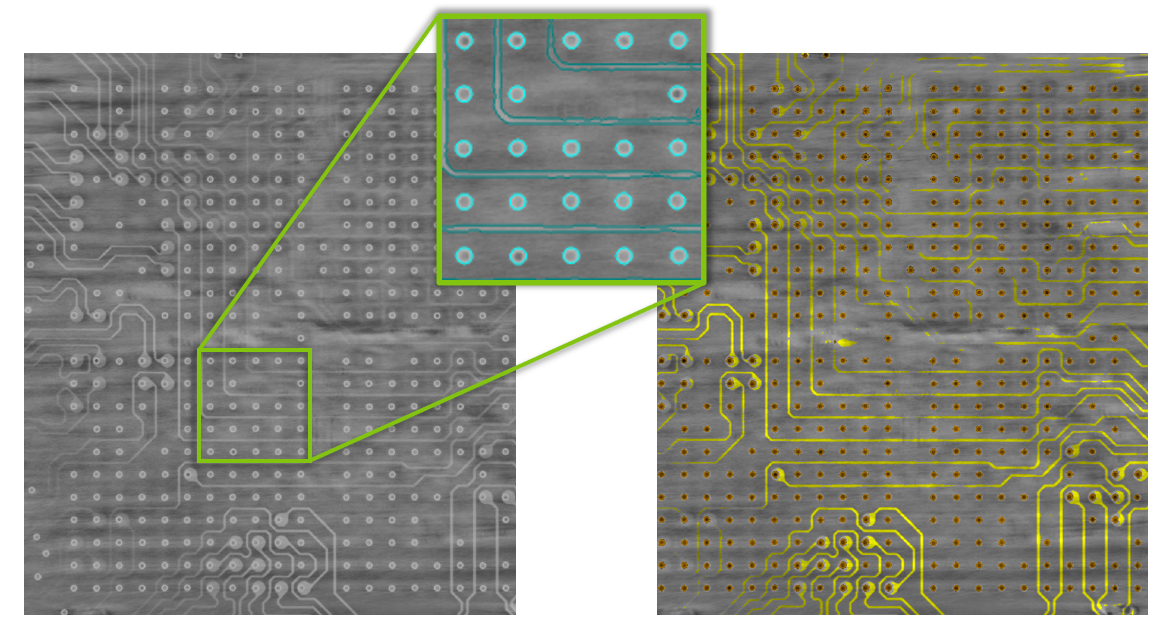
Figure 1
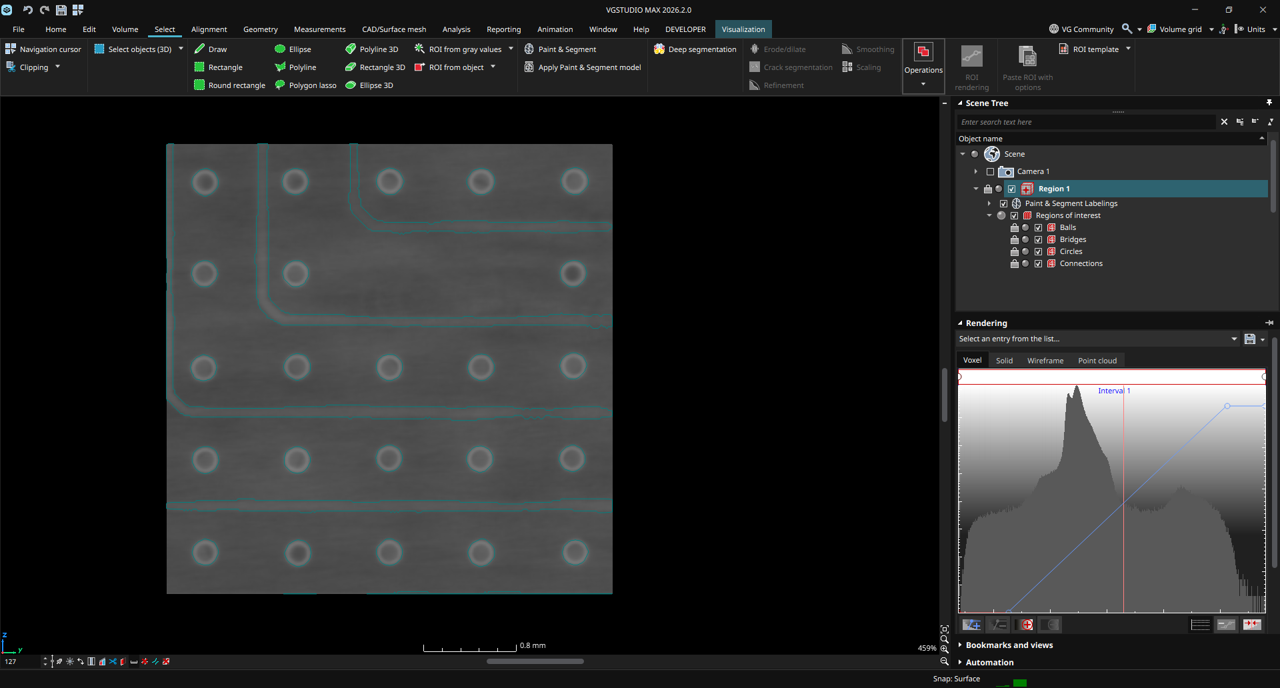
Figure 2
The result: precise, high-value data in a short amount of time
The DGA was impressed with the new possibilities for evaluating its CT datasets. “With VGTRAINER, we can perform faster analyses and be confident that the results are reliable every single time,” says the chargé d’expertise at DGA. Data quality remains consistently high thanks to the manually prepared and complementary training data. Patrick Fuchs adds: “By conducting technical analysis based on the deep neural network, we compensate for human factors such as fatigue, fluctuating concentration, or varying skill levels. The insights are highly precise and repeatable, leading to data-driven decisions.”
Collaboration also ran smoothly thanks to Hexagon’s global network: “We had a Hexagon colleague located very close by who responded quickly to any questions and easily arranged onsite meetings and discussions with additional experts,” the expert continues. This greatly simplified the test project.
““The high Speed of the evaluation is a tremendous benefit for us, particularly regarding our critical need for responsiveness,” the DGA representative concludes.”
DGA benefits from technical expertise, high security, and continuous analysis optimization
Another major advantage in security-critical applications is VGTRAINER’s cloud-independent data processing. All data processing takes place in the users’ own environment, ensuring that no security vulnerabilities arise from data transfer. This puts the DGA in an excellent position to expand its analyses and further optimize them in the future. Neither material nor part type poses any limitation: VGTRAINER segments any type of 3D voxel data, provided the appropriate training data is available.
“With this use case, we demonstrate how VGTRAINER can be used for postprocessing analyses of real CT data — combining speed, precision, and security, even in highly sensitive contexts,” Fuchs concludes.
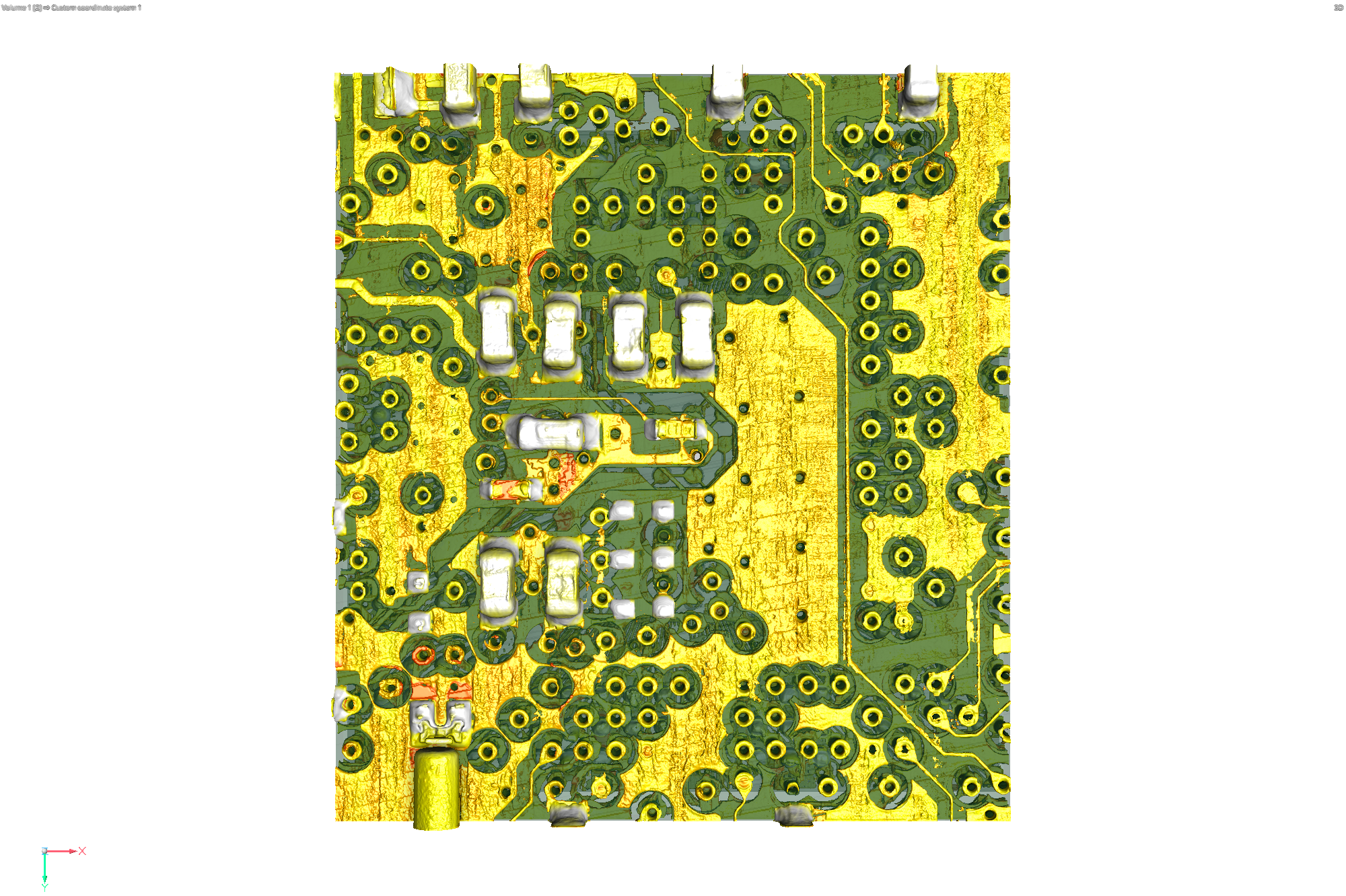
Figure 3