The science of deliciousness

10/2/2026
2 min
Tsukishima_CS

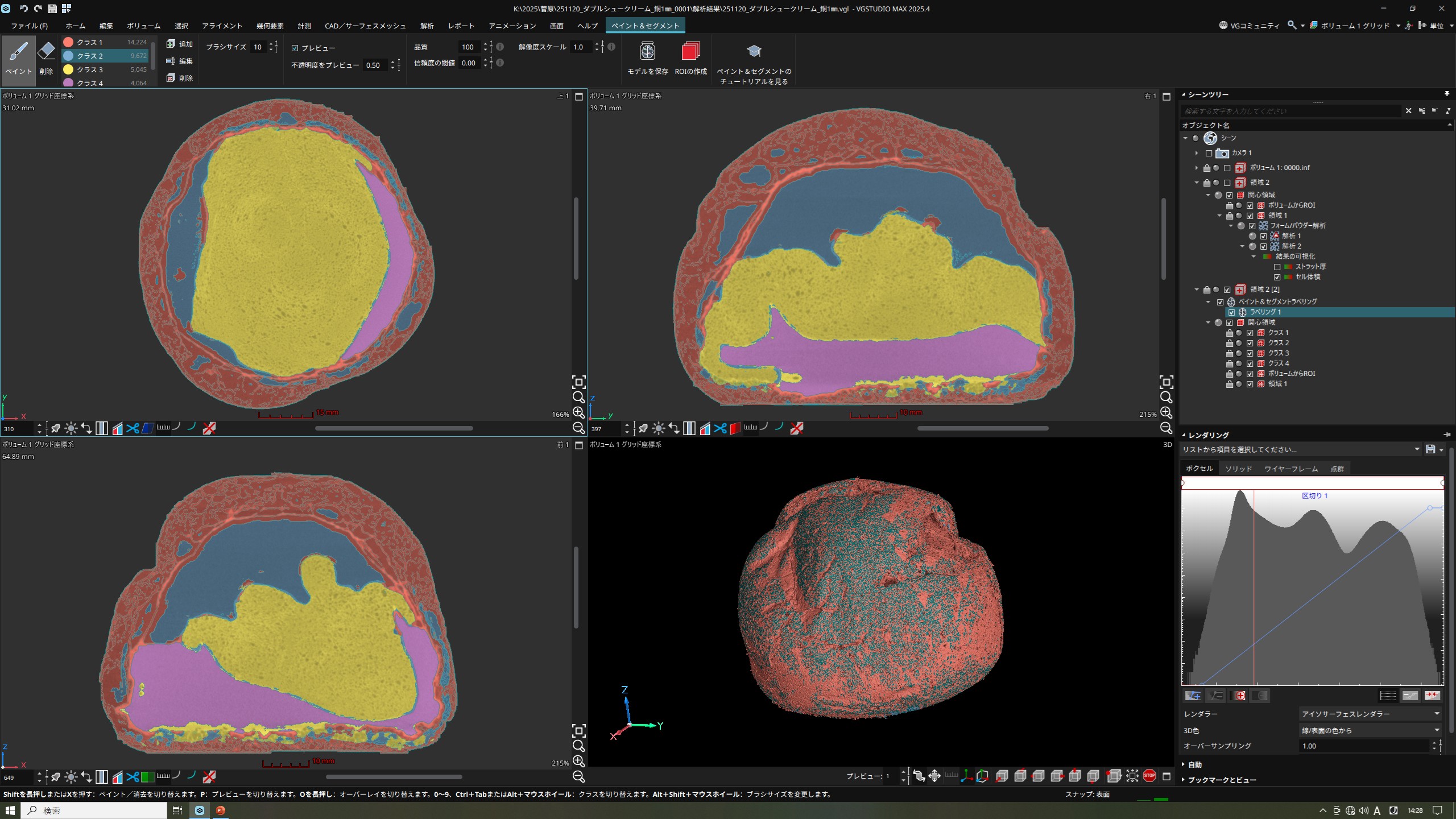
Fluffy cream puffs, crispy croissants: texture is what makes food delicious. Japanese ingredients manufacturer Tsukishima Food Industries uses industrial CT and VGSTUDIO MAX to turn texture from a matter of taste into hard data.


Tsukishima Food Industries Co., Ltd. has produced margarine, cream, and other processed oil and fat products for B2B customers since 1960. At its research institute, around 50 analytical methods are used for quality control and product development. One question has always been especially hard to answer: what exactly creates texture?
Cutting is not an option

Until recently, the only way to look inside food was to cut it open. With soft products like bread or cream puffs, though, the internal structure collapses the moment the knife goes in. Electron microscopes can show fine details, but they cannot explain how those details relate to the overall texture or fluffiness. Technical expert Mr Mizobe spent more than ten years looking for a technology that could capture the whole structure non-destructively and quantify it.

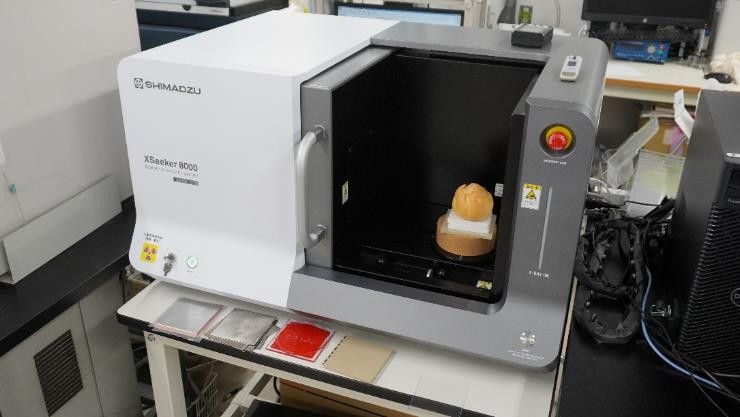
The breakthrough came with a compact benchtop CT system from Shimadzu. It cost and weighed about a tenth of the systems considered before, and could scan samples ten times larger. "I had expected it would take three to six minutes to scan with high precision, but I obtained a very clear image in about two minutes," Mr Mizobe recalls. A second deciding factor was VGSTUDIO MAX. The software made three-dimensional visualisation and analysis possible that had been out of reach with visual inspection alone.

From an artisan's instinct to scientific proof

Tsukishima supports its customers well beyond the ingredient itself, down to their manufacturing processes. In one project, the team used CT to study how the timing and amount of egg added to choux pastry affect its volume. Images and measurements showed that what had long been put down to the baker's experience actually comes from differences in how air bubbles form. "Being able to scientifically substantiate the transmission of these techniques is a major achievement," says Mr Mizobe.

The images are also convincing in customer conversations. During one development project, sensory tests suggested a prototype was close to the benchmark product, but there was no decisive proof. The team showed the client CT data of the internal cavity structure along with quantified volume measurements. "The client was surprised, exclaiming 'You can see this much!,' and the design was approved on the spot," says Mr Sugawara.

From three hours to 30 minutes


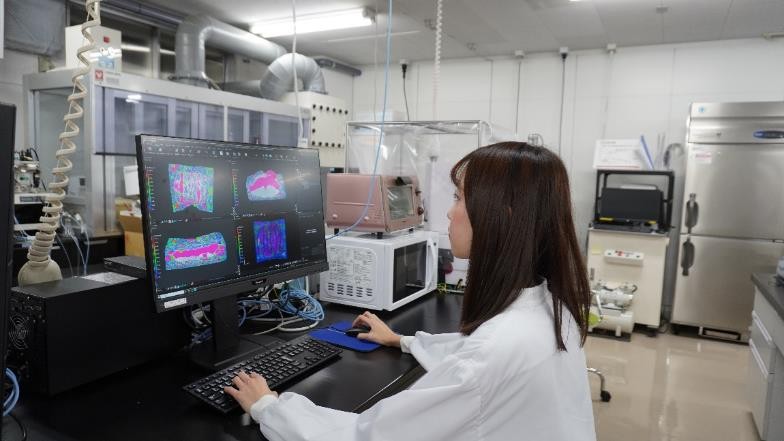
Analysing food, with its irregular structure, was difficult at first. A single analysis could take up to three hours. With the training and technical support included in the VGSTUDIO MAX premium support package, and with improvements in the software's segmentation capabilities, the team now finishes an analysis in about 30 minutes. "To fully harness the performance of the CT scanner, VGSTUDIO MAX and the support services are indispensable," says Mr Mizobe.


Fewer prototypes, faster development

Tsukishima is now building a systematic database. The team varies raw materials, recipes, and process conditions and records the resulting structures. Over time, this should reveal how to reach a target texture directly, cutting down on trial-and-error prototypes and speeding up development considerably.

The company plans to extend CT analysis beyond bread to cooked processed foods and baked goods. It is also looking at using CT to monitor wear in its factory equipment, and, as scanning speeds increase, possibly for in-line quality control.

"Research into the relationship between texture and structure is still in its pioneering stages," the research team says. With X-ray CT and VGSTUDIO MAX, Tsukishima has gained a scientific eye for what lies beyond deliciousness.

Safran Tech
10/17/2025
AI and Deep Learning drive enhancements in aerospace

Turbine blades are a critical component for jet engines. Ensuring their quality is not just a safety consideration; high-quality turbine blades ensure optimal engine performance, fuel efficiency, durability, and reduced emissions.

It’s important to remember here that the aerospace industry is not like the high-volume world of automotive where samples from the production line are tested. In aerospace, every blade must be tested.

Of course, embedding rigorous inspection processes into manufacturing also helps to detect potential turbine blade issues before they lead to failures. But such a rigorous inspection routine can involve multiple processes, such as tactile or optical 3D coordinate measuring machines (CMMs) for the external dimensions in tandem with computed tomography (CT) for internal dimensions and structure.

One manufacturer, Safran Tech, identified this as an area where efficiency improvements could be made. Safran Tech is part of Safran Group - the world’s second largest aircraft equipment manufacturer, employing over 92,000 people and generating 27.31 billion euros in revenue (2024).

Food Industry
Porosity/Inclusion Analysis
Visualization & Rendering
DGA_story
3/17/2026
More speed, less risk

How Hexagon empowers the French Defence Procurement Agency (Direction générale de l’armement, DGA) with 3D CT data segmentation using VGTRAINER and AI.


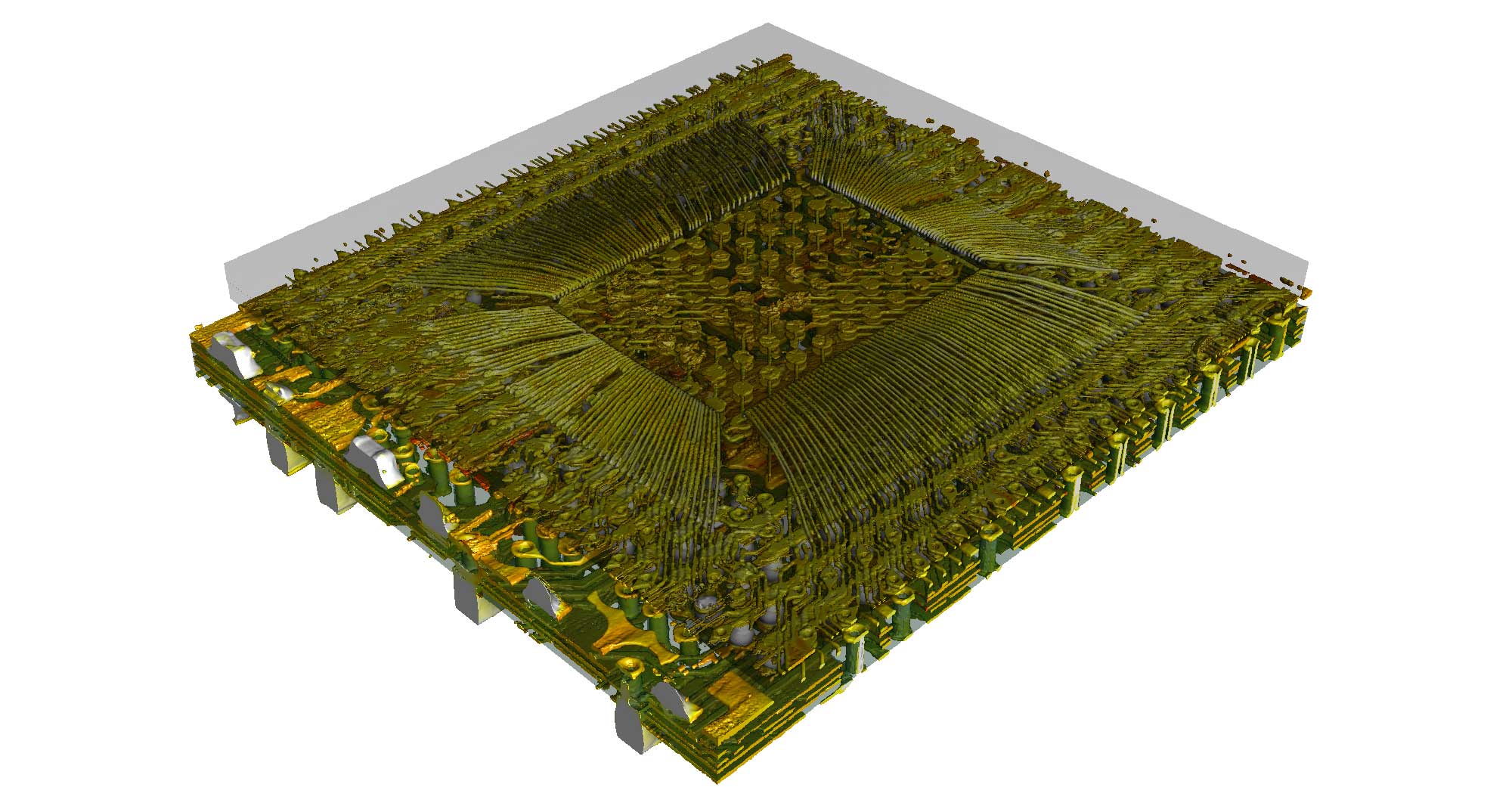
Until now, analysts at the Direction générale de l’armement (DGA) of the French Ministry of Defence needed a great deal of time to evaluate CT scans of printed circuit boards — one single board could take up to an entire day. Experts examined the data voxel by voxel to identify conductive connections between the vias and thus decode the circuitry. It was clear to the DGA: this process needed to be faster, more precise, and more wide ranging. With AI-based training using Hexagon’s VGTRAINER, evaluations can now be completed within seconds — while achieving higher accuracy and enabling larger data volumes to be processed efficiently in VGSTUDIO MAX.


When the DGA receives a new printed circuit board — such as from drones or other airborne systems with highly complex control mechanisms — analysts can look directly inside. Using computed tomography, the agency generates high-resolution 3D datasets, which are digitally evaluated during subsequent postprocessing. Every detail counts: The data reveals insights into internal structures, tight geometries, and even the smallest features such as traces and solder joints — completely non-destructively and without time-consuming physical sectioning. 


As France’s defense procurement authority, the DGA operates under substantial pressure for both speed and precision. For the design, assessment, and further development of defense systems and operations, correct information must be available as quickly as possible. This also applies to the postprocessing of complex 3D CT scans. That’s why some sites of the agency began collaborating with Hexagon as early as ten years ago and have since relied on software solutions such as VGSTUDIO MAX for non-destructive analysis. The department responsible for analyzing circuit boards has now taken another step forward: it explored the possibilities of automated data evaluation using artificial intelligence — and thereby its own optimization potential.

Food Industry
Porosity/Inclusion Analysis
Visualization & Rendering
Got a Story to share?
Whether it's a project milestone or a unique experience with Volume Graphics, our Storyteller Team looks forward to hearing from you!
Get in touch
put us to the test
Try VG for free

Get your free, 4-week trial license and see why we're the industry’s first and longest-trusted CT analysis software.

Request free trial